
The Ultimate Guide to
Warehouse
Management Systems
The Ultimate Guide to
AI Enabled Warehouse
Management
A comprehensive guide to transforming warehouse operations with AI-enabled visibility, smarter procurement alignment, real-time inventory intelligence, and connected supply chain decision-making.

The Future of Warehouse Management
The Future of Warehouse Management
AI is changing the way businesses manage warehouse operations, procurement decisions, supplier performance, and inventory planning. As supply chains become more complex, businesses need more than basic stock visibility. They need connected systems that can turn warehouse activity into real-time intelligence.
This guide explores how AI-enabled warehouse management helps businesses improve inventory accuracy, optimise inbound and outbound operations, strengthen procurement planning, reduce waste, manage exceptions, and make better decisions across the supply chain.
Modern warehouse management is no longer only about storing, picking, and dispatching goods. It is about using connected data, automation, and AI-supported insights to help businesses make faster, smarter decisions across procurement, inventory, operations, fulfilment, and supply chain planning.
The Big Picture: What Is AI-Enabled
Warehouse Management?
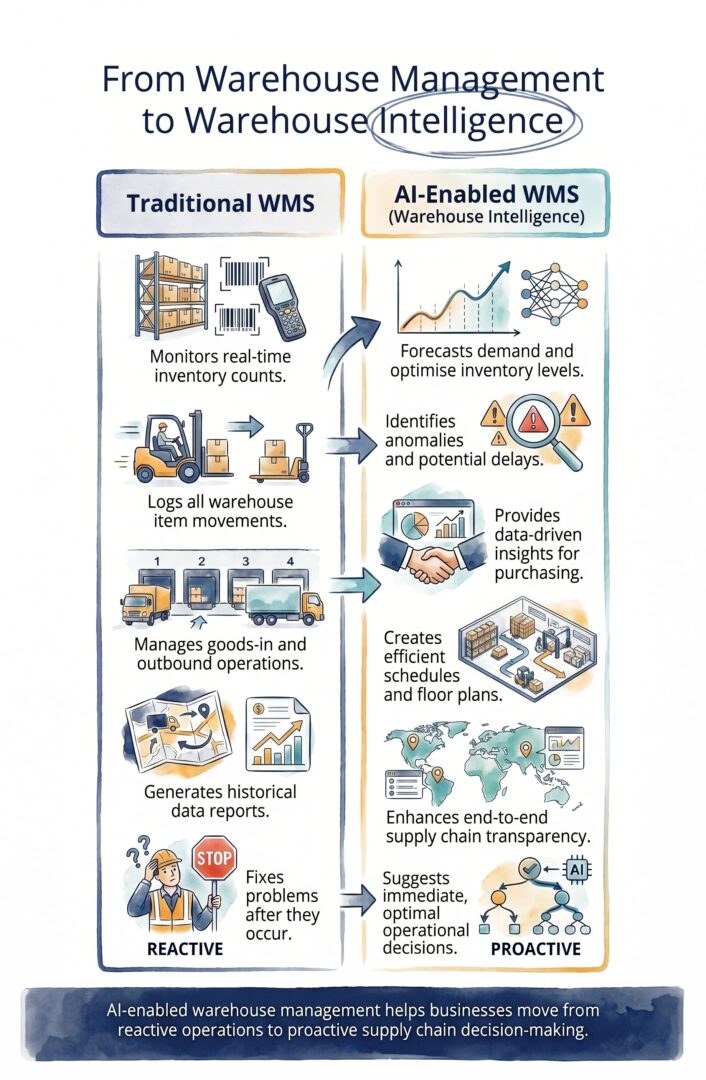
An AI-enabled Warehouse Management System builds on the core capabilities of a traditional WMS by using real-time operational data to improve decision-making across the warehouse. Instead of simply recording stock movements, it helps identify patterns, predict issues, recommend actions, and support better planning.
In a modern warehouse, AI can support demand forecasting, replenishment planning, labour allocation, slotting optimisation, exception management, and supplier performance insights. This makes the warehouse a more intelligent, connected part of the wider supply chain.
Procurement teams rely on accurate stock, supplier, and demand data to make better purchasing decisions. When warehouse data is connected to procurement processes, businesses can reduce overstocking, avoid stockouts, improve supplier performance, and align purchasing decisions with real operational demand.
Start your ai journey
AI That Drives Better
Warehouse and
Procurement Decisions

The Power of Traceability:
Surviving Product Recalls
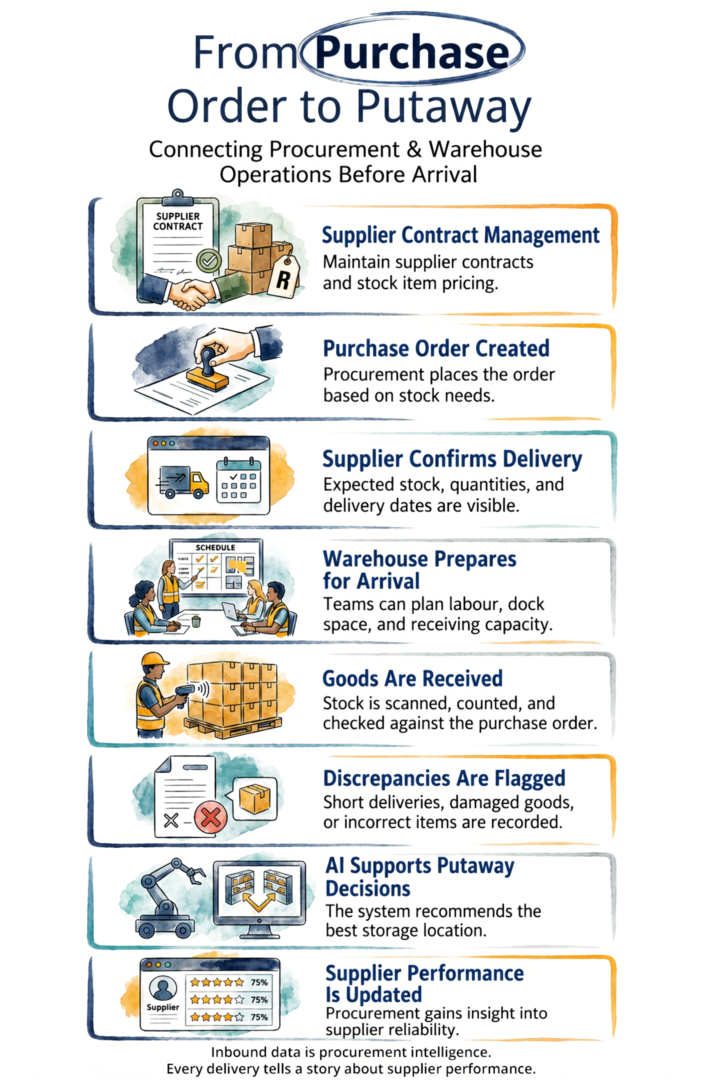
AI-enabled inbound operations help warehouse and procurement teams move from manual receiving processes to smarter, data-led coordination. By linking purchase orders, supplier information, delivery schedules, and real-time receiving data, the warehouse can prepare for incoming stock before it arrives.
When goods are received, the system can validate quantities, flag discrepancies, prioritise urgent stock, and guide workers to the most appropriate putaway locations. This reduces delays, improves stock accuracy, and gives procurement teams better insight into supplier reliability.
Turn Every Delivery into Actionable Data
Inbound warehouse activity doesn't just update inventory; it provides procurement with measurable supplier performance data. Track late deliveries, shortages, damaged goods, labelling issues, and specification compliance to improve future purchasing decisions.


Late
Deliveries

Shipment
Shortage

Damaged
Goods

Incorrect
Labelling

Specification
Compliance
Late
Deliveries
Shipment
Shortage
Damaged
Goods
Incorrect
Labelling
Specification
Compliance

Mastering Real-Time Inventory Intelligence
Real-time inventory visibility is the foundation of AI-enabled warehouse management. Accurate stock data allows businesses to understand what is available, where it is located, how quickly it is moving, and when it may need to be replenished.
AI can enhance this visibility by identifying unusual stock movements, predicting shortages, highlighting slow-moving inventory, and recommending replenishment actions based on demand patterns. This helps businesses avoid both stockouts and unnecessary overstocking.
Procurement teams can use real-time warehouse data to place smarter orders. Instead of relying only on historical purchasing cycles, they can make decisions based on live stock availability, demand signals, supplier lead times, and consumption trends.

Real-Time Stock Accuracy
Live stock updates across locations help procurement and operations work from the same source of truth.
Real-Time Stock Accuracy
Live stock updates across locations help procurement and operations work from the same source of truth.

Predictive Replenishment
AI-supported replenishment can recommend when to reorder based on demand, stock velocity, lead times, and safety stock levels.
Predictive Replenishment
AI-supported replenishment can recommend when to reorder based on demand, stock velocity, lead times, and safety stock levels.

Slow-Moving and Excess Stock Detection
AI can identify stock that is not moving as expected, helping procurement avoid repeat overbuying.
Slow-Moving and Excess Stock Detection
AI can identify stock that is not moving as expected, helping procurement avoid repeat overbuying.
Demand-Linked Inventory Planning
Warehouse data can be connected to sales, procurement, and ERP data to improve planning accuracy.
Demand-Linked Inventory Planning
Warehouse data can be connected to sales, procurement, and ERP data to improve planning accuracy.
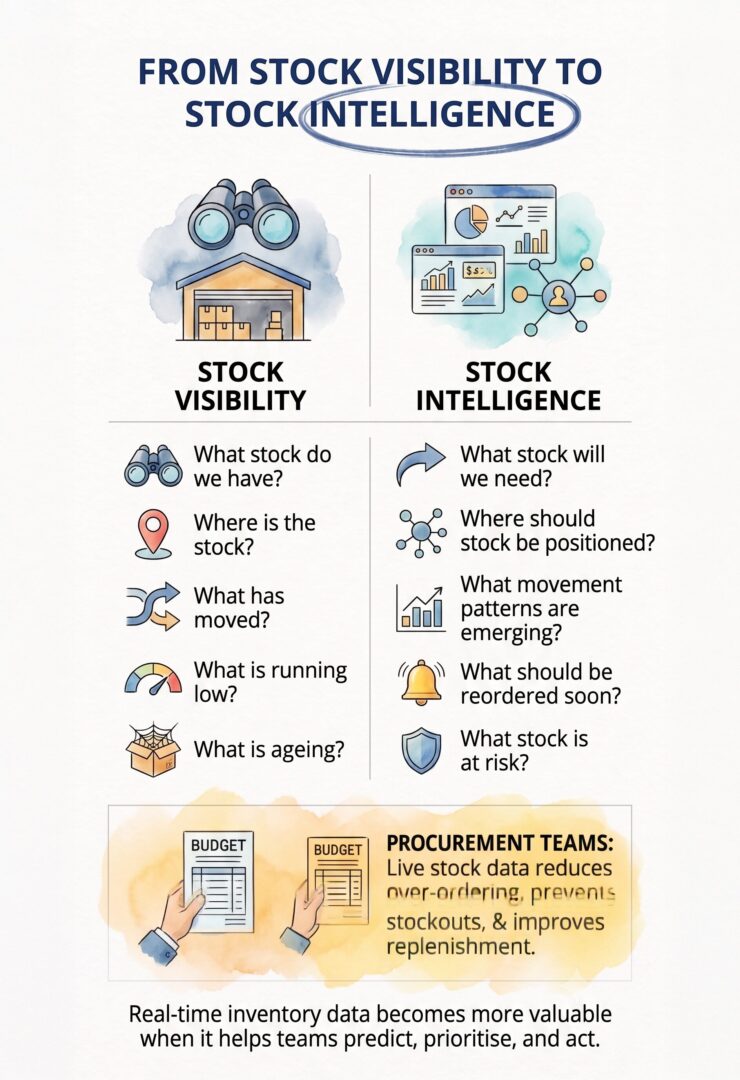

Procurement Meets Warehouse
Management: Smarter Buying Starts with
Better Stock Data
Procurement and warehouse management are often treated as separate business functions. In reality, they are closely connected. Every purchasing decision eventually becomes a warehouse activity, and every warehouse issue creates valuable procurement insight.
When procurement teams have access to accurate warehouse data, they can make more informed decisions about what to buy, when to buy, how much to buy, and which suppliers to rely on. AI strengthens this connection by turning operational data into practical recommendations.

Supplier Performance Visibility
Track delivery accuracy, lead-time reliability, damaged goods, short deliveries, and compliance issues.

Reorder Optimisation
Use live inventory data, demand trends, and supplier lead times to improve replenishment planning.

Reduced Overstocking
Identify excess stock and slow-moving products before they create unnecessary holding costs.

Improved Procurement Timing
Align purchase decisions with actual consumption, promotions, seasonal demand, and warehouse capacity.

Better Supplier Negotiations
Use performance data to support supplier reviews, pricing discussions, service-level agreements, and corrective action plans.
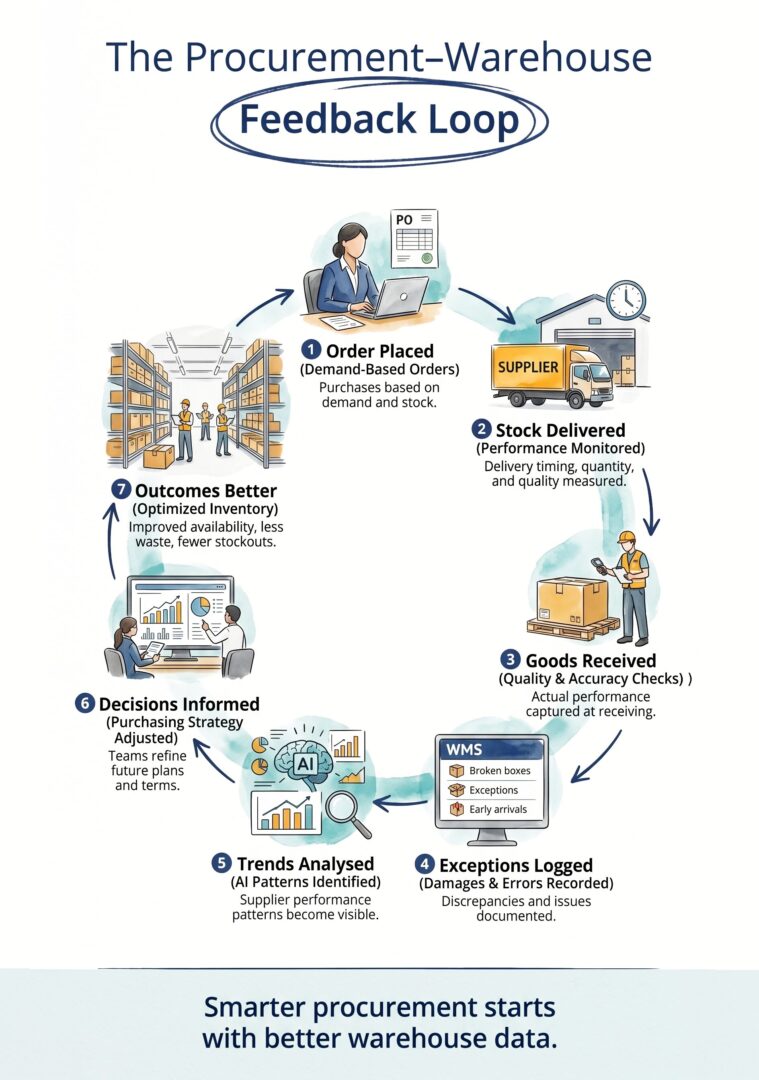
Turn Data into Better
Procurement Decisions
Procurement does not become smarter by working harder.
It becomes smarter by working with better data.
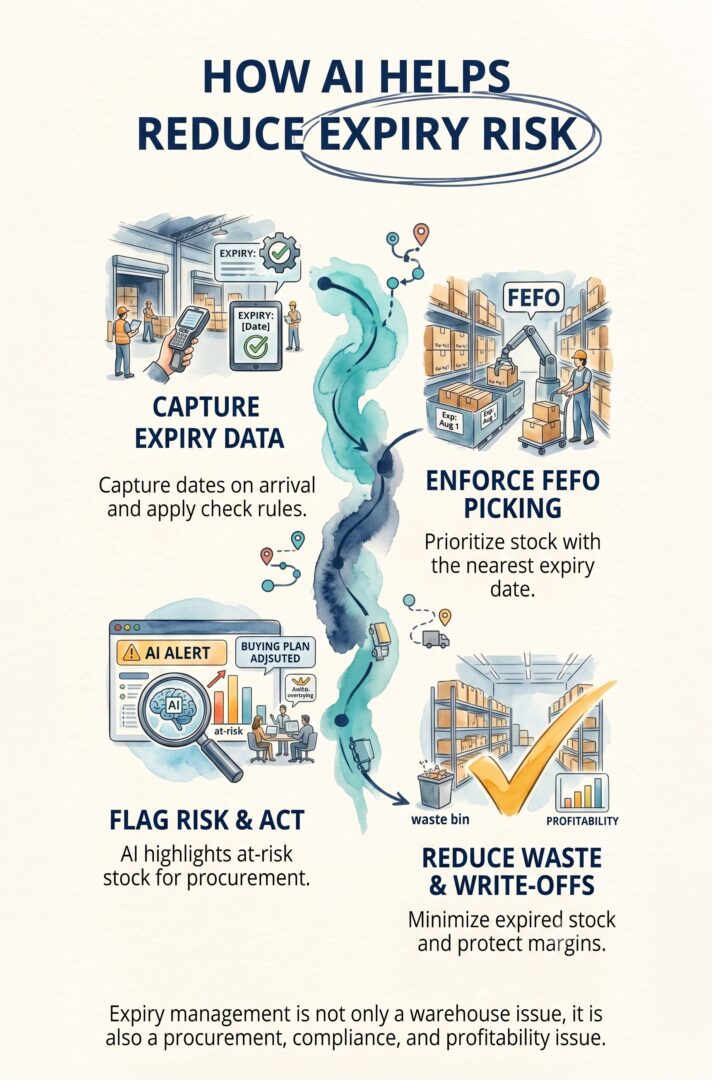
Racing Against Time: Expiry Dates, Stock
Rotation, and Procurement Planning
For industries such as food, pharmaceuticals, healthcare, and chemicals, expiry management is not only a warehouse function. It is a procurement, compliance, and customer service priority.
An AI-enabled WMS can help enforce FEFO rules, monitor shelf life, block expired stock, and highlight products at risk of expiry. When this data is shared with procurement, teams can adjust purchasing volumes, review supplier lead times, reduce over-ordering, and avoid unnecessary waste.
Procurement teams need expiry and shelf-life visibility to make better buying decisions. Ordering too much stock, ordering too early, or selecting suppliers with long lead times can increase the risk of expiry-related losses.

THE DOVETAIL PERSPECTIVE
The Power of Traceability:
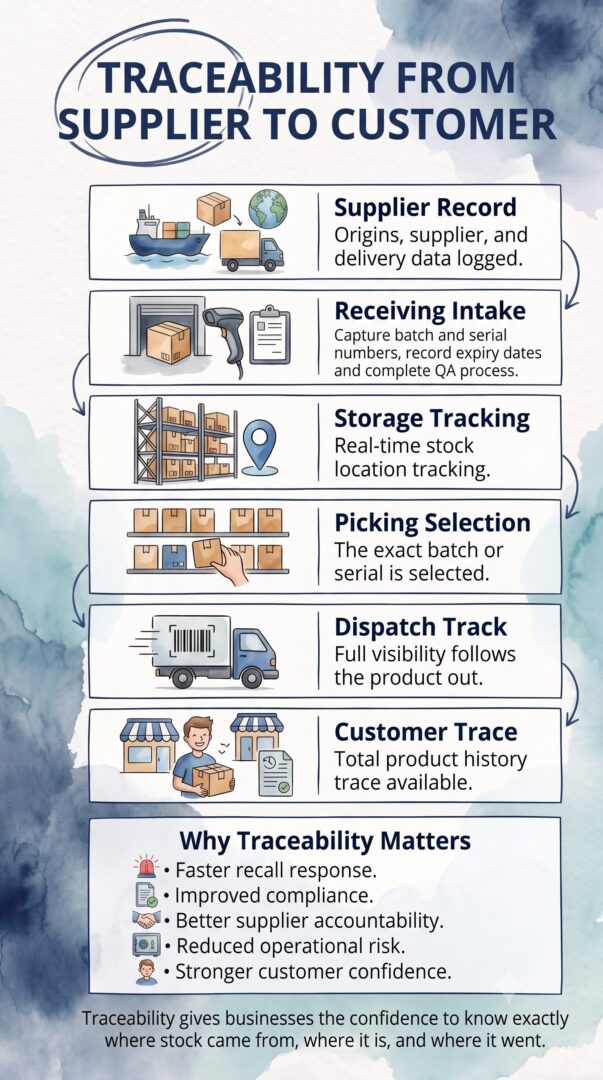
From Supplier to Customer
Traceability
Traceability gives businesses the ability to follow products from supplier receipt through storage, picking, dispatch, and customer delivery. In the event of a recall, contamination issue, quality concern, or supplier defect, this visibility is essential.
AI-enabled
An AI-enabled approach can help detect recurring quality issues, identify affected batches faster, and highlight supplier patterns that may require procurement action.
Traceability helps procurement move beyond price-based supplier management. It gives procurement teams evidence of supplier quality, compliance, delivery accuracy, and product reliability.

Streamlining Outbound Operations:
Picking, Packing, and Demand Signals
AI-enabled warehouse management works best when it is connected to the technologies that execute warehouse activity. Robotics, barcode scanning, RF devices, mobile applications, voice-directed picking, conveyors, and automated material handling systems all create valuable operational data.
AI can use this data to support better task allocation, improve space utilisation, balance workloads, identify bottlenecks, and recommend operational improvements.
Accurate warehouse data provides the business with reliable insights to support informed investment decisions regarding automation technologies such as Voice Picking, Pick-to-Light systems, robotics, and other advanced warehouse automation solutions.

AI-Supported Picking Strategies
Wave, batch, zone, and priority picking can be optimised based on order profiles.

Demand-Driven Procurement Signals
Fast-moving items can trigger procurement review before stockouts occur.

Backorder Visibility
Procurement can see where supplier or stock availability issues are affecting customer fulfilment.

Improved Customer Service
Better stock availability improves order fulfilment and customer satisfaction.
AI-Supported Picking Strategies
Wave, batch, zone, and priority picking can be optimised based on order profiles.
Demand-Driven Procurement Signals
Fast-moving items can trigger procurement review before stockouts occur.
Backorder Visibility
Procurement can see where supplier or stock availability issues are affecting customer fulfilment.
Improved Customer Service
Better stock availability improves order fulfilment and customer satisfaction.

THE DOVETAIL PERSPECTIVE
Handling Complexity:
Returns, Quarantine, Quality Assurance, and Supplier Accountability
Warehouse exceptions are often procurement signals in disguise. Returns, damaged stock, incorrect products, poor labelling, failed quality checks, and quarantined items may all point to supplier, sourcing, or purchasing issues.
An AI-enabled WMS helps capture these exceptions consistently and makes them visible to the right teams. Instead of treating every exception as an isolated warehouse problem, the business can analyse patterns and take corrective action.
Procurement teams can use exception data to manage supplier performance, renegotiate terms, adjust supplier scorecards, and reduce recurring quality issues.
Returns Intelligence
Identify recurring reasons for returns and link them to products, suppliers, or customers.
Digital Quarantine
Prevent suspect stock from being allocated until it is inspected and released.
Supplier Quality Insights
Track which suppliers are associated with damaged, short, expired, or non-compliant stock.
Corrective Action Planning
Use warehouse evidence to support supplier performance reviews.

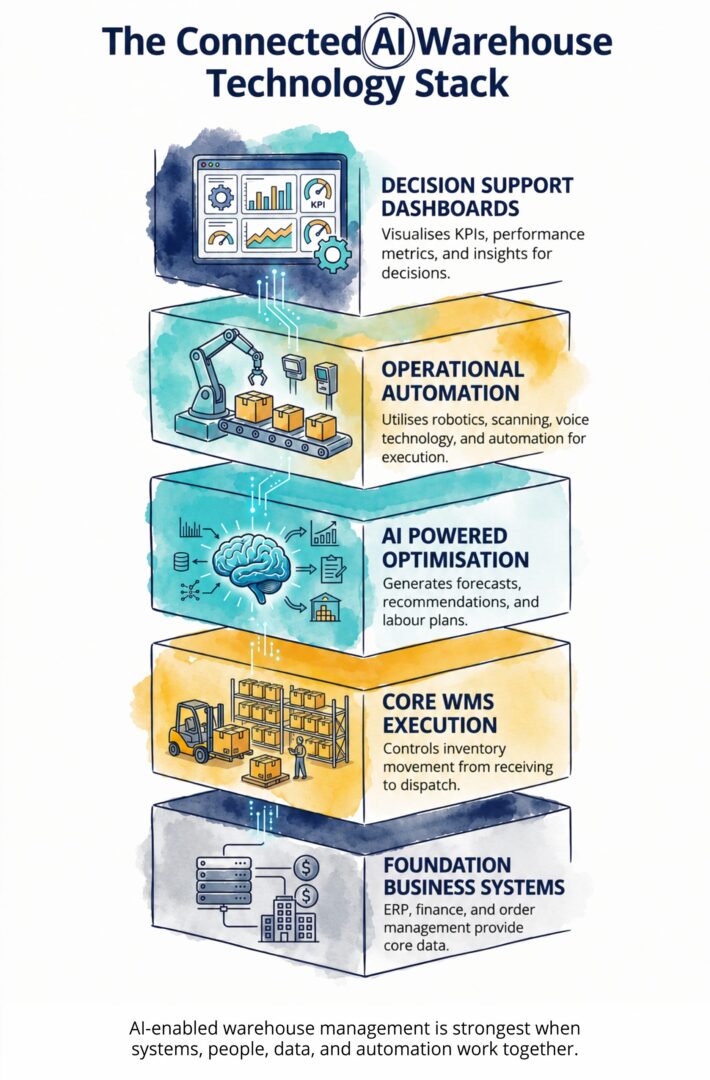
Next-Generation Technologies: AI, Automation, Robotics, and Voice Systems
AI-enabled warehouse management works best when it is connected to the technologies that execute warehouse activity. Robotics, barcode scanning, RF devices, mobile applications, voice-directed picking, conveyors, and automated material handling systems all create valuable operational data.
AI can use this data to support better task allocation, improve space utilisation, balance workloads, identify bottlenecks, and recommend operational improvements.
Accurate warehouse data provides the business with reliable insights to support informed investment decisions regarding automation technologies such as Voice Picking, Pick-to-Light systems, robotics, and other advanced warehouse automation solutions.
Navigating 3PL and Multi-Client Environments with AI
Third-party logistics environments are complex because they often manage multiple clients, product categories, suppliers, service-level agreements, billing rules, and reporting requirements from one operation.
AI-enabled warehouse management can help 3PL providers identify operational patterns across clients, forecast capacity pressure, improve labour planning, and detect SLA risks before they become service failures.
For 3PL clients, procurement visibility is critical. They need accurate information on stock availability, supplier deliveries, inbound delays, and exceptions. A connected WMS can provide procurement teams with better visibility into how supplier performance affects warehouse execution and customer service.


Multi-client
inventory
visibility

Client-specific
receiving and
fulfilment rules
SLA
monitoring

Supplier delivery
performance by
client

Real-time
portals
Billing
accuracy

Exception
reporting

Real-time
visibility for
3PL clients

Strategic Implementation: Connecting WMS, ERP,
Procurement, TMS, and Analytics
AI-enabled warehouse management depends on connected systems and reliable data. A WMS cannot deliver its full value in isolation. It needs to integrate with ERP, procurement, transport management, eCommerce, finance, supplier systems, and analytics platforms.
When these systems work together, businesses gain end-to-end visibility from supplier order to warehouse receipt, inventory movement, customer fulfilment, transport execution, and financial reporting.
Procurement integration ensures that purchasing decisions are informed by live warehouse realities. This helps align buying activity with demand, stock availability, supplier performance, and operational capacity.
ERP integration
Procurement and purchase order integration
TMS integration
eCommerce and order management integration
Supplier performance data
AI-ready data foundations
Dashboards and KPI reporting
Change management and user adoption
Turn Warehouse
Data into Business Intelligence
AI is only as powerful as the data it can access. Connect your
warehouse systems to unlock real-time insights,
smarter automation, and better business decisions.
The Big Payoff:
Why AI-Enabled WMS Matters
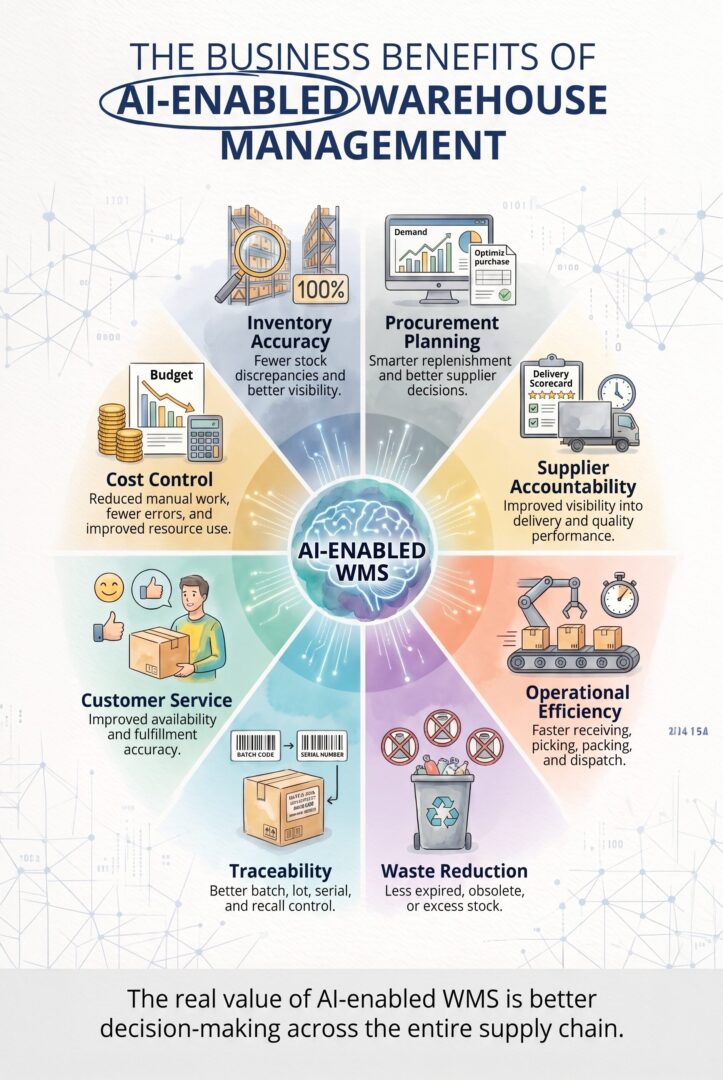
The value of AI-enabled warehouse management is not limited to faster picking or better stock control. It can improve decision-making across the entire supply chain.
By connecting warehouse data with procurement, transport, finance, and customer fulfilment, businesses can reduce waste, improve supplier accountability, increase inventory accuracy, control costs, and respond faster to change.

Dovetail
7 Critical Questions
A successful AI strategy begins with data readiness, not the technology itself. Businesses should assess whether warehouse information is fragmented, manual processes are slowing operations, supplier performance is difficult to measure, or inventory decisions rely on incomplete or outdated data.
When warehouse data is connected across procurement, inventory, and operations, AI becomes more than an automation tool. It becomes a strategic capability that delivers real-time intelligence, improves decision-making, and helps businesses operate with greater accuracy, agility, and confidence.
Decision Framework
Assess Your Readiness for AI-Driven Warehouse Management

Is your warehouse data accurate enough to support better decisions?
If inventory records are unreliable, procurement, sales, operations, and finance all make decisions from flawed information.
Your WMS should support:
- Real-time stock visibility
- Accurate receiving and dispatch data
- Lot, batch, serial, and expiry tracking
- Cycle counting and stock reconciliation
- Exception visibility

Can procurement see what is really happening in the warehouse?
Procurement needs more than supplier pricing and purchase order history. It needs operational evidence.
Your system should help procurement understand:
- Supplier delivery reliability
- Short deliveries
- Damaged stock
- Expiry and shelf-life issues
- Slow-moving stock
- Replenishment risks

Can the system help prevent stockouts and overstocking?
AI-enabled warehouse management should support smarter replenishment by combining demand, stock, and supplier lead-time data.
Look for capabilities that support:
- Reorder recommendations
- Demand pattern analysis
- Safety stock planning
- Slow-moving stock alerts
- High-velocity SKU monitoring

Does it support complex inbound, outbound, and exception workflows?
Real warehouses are not linear. They deal with returns, quarantines, substitutions, urgent orders, damaged goods, recalls, and supplier discrepancies.
Your WMS should support:
-
Structured receiving
-
Directed putaway
-
Picking optimisation
-
Returns management
-
Digital quarantine
-
QA controls
-
Exception reporting

Can it connect with ERP, procurement, TMS, and eCommerce systems?
AI-enabled operations require connected data.
Your WMS should integrate with:
- ERP systems
- Procurement and purchase order workflows
- TMS platforms
- eCommerce and order management platforms
- Supplier and customer portals
- Analytics and reporting tools

Can it support automation and future growth?
Your WMS should be ready for new operational technologies and changing business models.
It should support:
- Barcode and RF scanning
- Mobile workflows
- Voice-directed picking
- Robotics and automation
- Multi-site operations
- Multi-client 3PL environments
- Advanced analytics

Does it turn operational data into strategic insight?
The right WMS should not only record activity. It should help the business understand what is happening, why it is happening, and what to do next.
Look for insight into:
- Supplier performance
- Inventory risk
- Warehouse productivity
- Fulfilment accuracy
- Stock ageing
- Demand trends
- Procurement opportunities
- Cost drivers